Toptimum Performance · Scientific guide
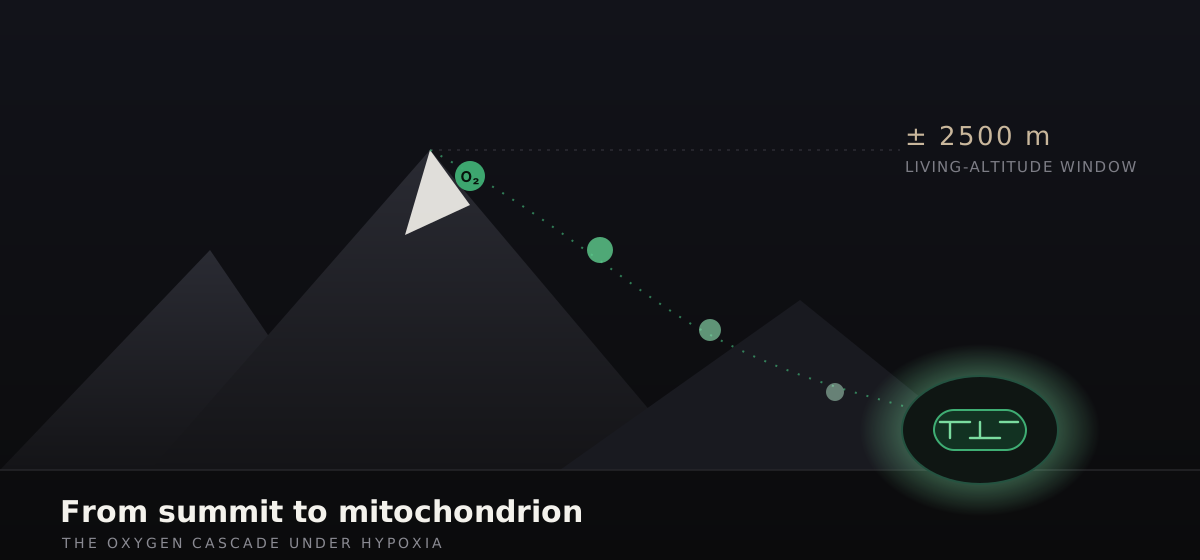
From summit to mitochondrion
Altitude and hypoxic training

The Altitude Guide

From the oxygen cascade to the training decision — the complete scientific guide to altitude and hypoxic training for coaches and ambitious athletes.
Free preview
Toptimum Performance
From hypoxia to adaptation
From hypoxia to adaptation · What you get

Eight chapters, one foundation

This short preview gives you a taste of Chapter 1. The complete guide builds from the physiology of hypoxia to planning, preparing and monitoring an altitude period — the complete foundation for anyone working with altitude.

1What altitude does to oxygenpreview below ↓
2How the body adaptslockedThe haematological and non-haematological route: from EPO to a larger haemoglobin mass.
3The methods and what they are worthlockedLive high–train low and the other models, and what they are really worth.
4The right doselockedThe living-altitude window, the duration and the dose: how much altitude is enough.
5Planning the altitude camplockedTiming, build-up and the return towards competition.
6Iron, nutrition and healthlockedIron status, ferritin thresholds, supplementation and health before departure.
7Monitoring and individualisinglockedWhat to measure, how to monitor and steer the response per athlete.
8Myths and the limits of the evidencelockedWhat the evidence does and does not support.
The Altitude Guide · From hypoxia to adaptation
Chapter 1

What altitude does to oxygen

The oxygen cascade from air to mitochondrion, what exactly changes at lower air pressure, and why your runner runs slower at altitude for the same effort.

Altitude training comes down to one molecule and one journey: how oxygen gets from the outside air all the way into the mitochondria of the working muscle. Anyone who understands that journey understands why altitude works, why the gain is small and individual, and why the preparation begins weeks before the camp.

A great deal of mythology surrounds altitude training: "thin air", "less oxygen", "your blood gets thicker". These images are not wrong, but they are too crude to build training decisions on. The literature of the past 25 years keeps pointing to the same pattern: altitude acts on oxygen transport, the gain is modest (typically under 2% on sport-specific performance), and it differs greatly from athlete to athlete (Lundby, Millet & Calbet, 2012; Girard, Levine, Chapman & Wilber, 2023). To be able to steer that gain, you first have to see what happens physiologically the moment your runner starts living higher — not as isolated facts, but as one coherent journey from molecule to mitochondrion.
The Altitude Guide

The Altitude Guide

This is a short taster. The full free preview and the complete guide — 80 pages, 15 figures and 26 sources, supported with sources and references (with DOIs where available) — are available in the store.

View in the store →
Toptimum PerformanceThe Altitude Guide · free preview

Free preview — open in the browser.