Part I

What lactate really is
How lactate forms
To interpret lactate tests correctly, you first have to understand how lactate forms. Not superficially, and not through the classic myth of "oxygen shortage", but from the actual biochemistry of exercise.
Lactate is not an incidental by-product that appears only when the body fails. It is a normal, continuous and functional part of human energy metabolism. During running, muscle tissue must constantly regenerate ATP — the direct energy currency for muscle contraction, ion transport and calcium handling. Because the ATP store in the muscle is small, it must be permanently replenished through several cooperating routes: phosphocreatine breakdown, glycolysis and oxidative phosphorylation. These systems do not work one after another as if switches were being flipped, but simultaneously, in shifting relative contribution depending on intensity, duration, training state, fibre recruitment and fuel availability (Gastin, 2001).
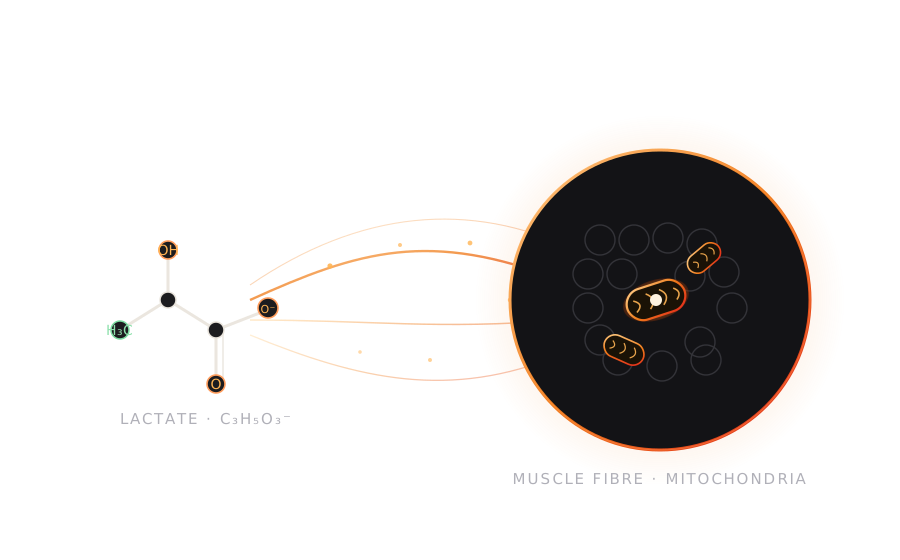
Within that integrated system, lactate forms mainly in relation to glycolysis: the route in which glucose or muscle glycogen is broken down to pyruvate, with production of ATP and reduction of NAD⁺ to NADH. Pyruvate can be processed towards the mitochondria, but through lactate dehydrogenase it can also be converted into lactate. That conversion is not an emergency solution — it preserves the redox balance, keeps glycolytic ATP production possible and distributes carbon between cells and organs. Rogatzki, Ferguson, Goodwin and Gladden (2015) put it sharply: lactate can functionally be regarded as the normal end product of glycolytic flux. The question is therefore not whether lactate forms, but how much, where it goes, how quickly it is used, and how much of it ultimately appears in the blood.
 The Lactate Guide — Part I · free preview