
De Lactaatgids — Deel I is erThe Lactate Guide — Part I is here

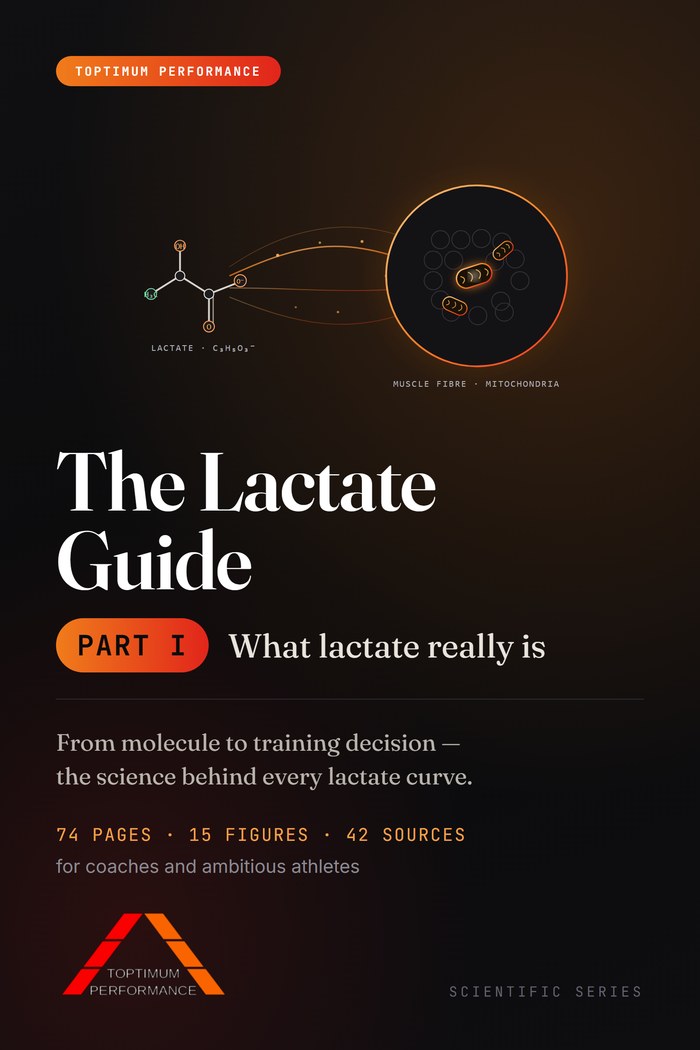
Er is een nieuwe premiumgids: De Lactaatgids — Deel I, 77 pagina’s over wat lactaat écht is, van molecuul tot trainingsbeslissing. Vijftien figuren, 42 wetenschappelijke bronnen. Hieronder drie dingen eruit die de meeste lopers verrassen.There is a new premium guide: The Lactate Guide — Part I, 74 pages on what lactate actually is, from molecule to training decision. Fifteen figures, 42 scientific sources. Here are three things from it that surprise most runners.
Dezelfde waarde, twee tegengestelde lopersThe same value, two opposite runners
Twee lopers die bij hetzelfde tempo allebei 4,0 mmol/L meten, kunnen fysiologisch elkaars tegenpool zijn. Een lactaatmeter leest een stand af, geen snelheid: bij de ene gaat er weinig lactaat de bloedpool in en uit, bij de andere stroomt er een veelvoud doorheen dat even snel weer verwerkt wordt. De ene heeft dus ruimte om zijn of haar glycolytisch vermogen uit te bouwen, de andere wint meer aan de verwerkingskant.Two runners who both read 4.0 mmol/L at the same pace can be physiological opposites. A lactate meter shows a level, not a rate: in the one, little lactate enters the blood pool and little leaves it; in the other, a multiple flows through and is cleared away just as fast. The first therefore has room to build their glycolytic power, the second gains more on the processing side.
Melkzuur zit nauwelijks in je benenThere is barely any lactic acid in your legs
Melkzuur en lactaat zijn twee toestanden van dezelfde stof; welke overheerst, hangt af van de zuurtegraad. Melkzuur staat zijn proton af vanaf een pKa van ongeveer 3,86, en de pH in een spiercel ligt tussen 6,4 en 7,1. Meer dan 99,7 procent is dus altijd lactaat. De reactie die lactaat vormt, neemt bovendien een proton óp: ze remt de verzuring af in plaats van ze te veroorzaken (Robergs e.a., 2004).Lactic acid and lactate are two states of the same substance, and which one dominates depends on the acidity around it. Lactic acid gives up its proton from a pKa of about 3.86 onwards, while the pH inside a muscle cell sits between 6.4 and 7.1. More than 99.7 per cent of it is therefore always lactate. The reaction that forms lactate moreover takes up a proton: it retards acidification rather than causing it (Robergs et al., 2004).
De “anaerobe afstand” bestaat nietThe “anaerobic distance” does not exist
Duffield en collega’s (2005) lieten zestien getrainde 400 m-atleten en elf 800 m-atleten — mannen én vrouwen — hun afstand echt lopen en rekenden de energieverdeling uit. Op de 400 m kwam ongeveer 41 procent aeroob bij de mannen en 45 procent bij de vrouwen; op de 800 m liep dat op tot 60 en 70 procent. Een inspanning van twee minuten haalt dus het merendeel van haar energie uit het oxidatieve systeem.Duffield and colleagues (2005) had sixteen trained 400 m athletes and eleven 800 m athletes — men and women — actually run their distance and worked out the energy split. On the 400 m about 41 per cent was aerobic in the men and 45 per cent in the women; on the 800 m that rose to 60 and 70 per cent. An effort of two minutes therefore draws the majority of its energy from the oxidative system.
Bekijk de Lactaatgids op PayhipView the Lactate Guide on Payhip →
Alles over de gidsAll about the guideAlle gidsen in de BibliotheekAll guides in the Library →