
De Lactaatgids — Deel II is erThe Lactate Guide — Part II is here
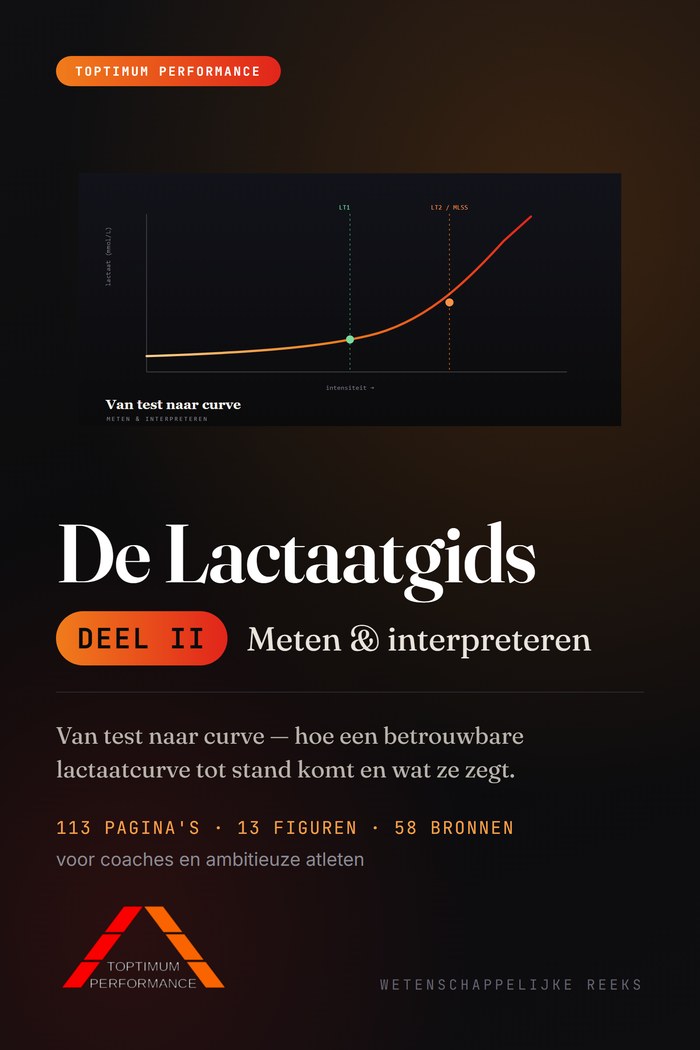
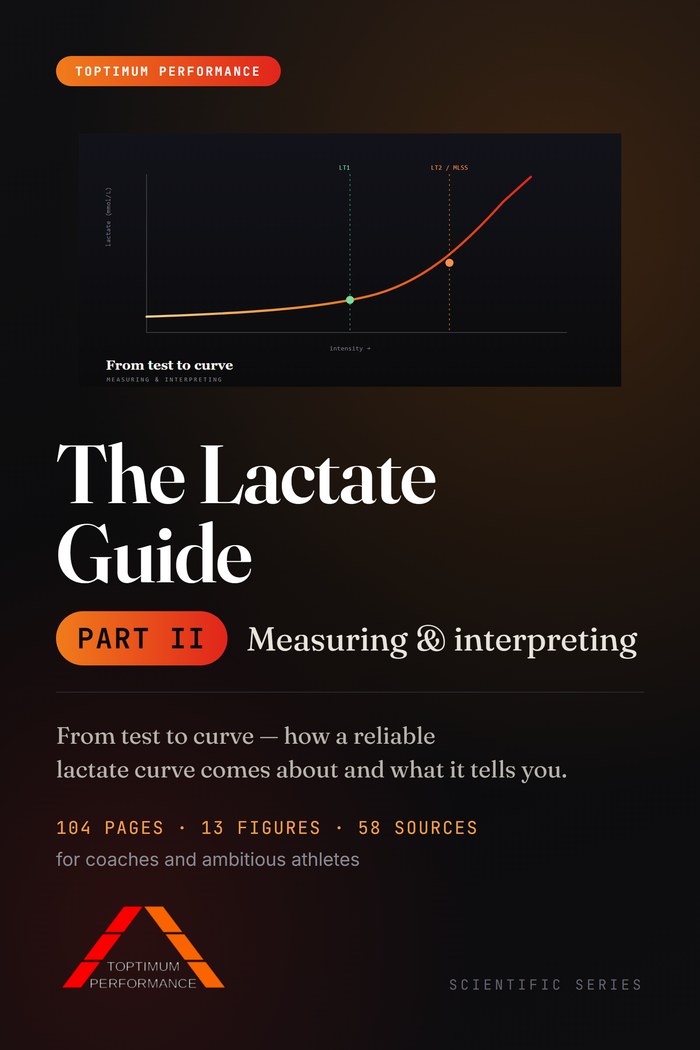
Er is een nieuwe premiumgids: 113 pagina’s over het meten en lezen van een lactaatcurve. Deel I legt uit wát lactaat is; Deel II gaat over de test zelf — drempelkeuze, protocol, bemonstering en het juiste moment om te hertesten. Dertien figuren, 58 wetenschappelijke bronnen. Hieronder drie dingen eruit die de meeste coaches verrassen.There is a new premium guide: 104 pages on measuring and reading a lactate curve. Part I explains what lactate is; Part II is about the test itself — threshold choice, protocol, sampling and the right moment to retest. Thirteen figures, 58 scientific sources. Here are three things from it that surprise most coaches.
Achter elk drempelgetal zit een keuzeBehind every threshold number sits a choice
Faude, Kindermann en Meyer (2009) verzamelden in hun overzichtsartikel niet minder dan 25 verschillende drempelconcepten en brachten ze onder in drie families. Op één en dezelfde curve leggen de vaste 2- en 4-mmol-waarden, log-log en Dmax elk een andere snelheid vast. Een drempel is dus geen harde meetwaarde maar een schatting binnen een gekozen definitie. Wie niet weet welke methode achter het getal zit, weet ook niet wat hij of zij ermee mag doen.Faude, Kindermann and Meyer (2009) catalogued no fewer than 25 different threshold concepts in their review and sorted them into three families. On one and the same curve, the fixed 2- and 4-mmol values, log–log and Dmax each fix a different speed. A threshold is therefore not a hard measured value but an estimate within a chosen definition. If you do not know which method sits behind the number, you do not know what you may do with it either.
Drie of zes minuten per trap scheelt anderhalve kilometer per uurThree or six minutes per step makes one and a half kilometres per hour of difference
Kuipers en collega’s (2003) lieten acht goed getrainde lopers dezelfde loopbandtest afleggen met trappen van één, drie en zes minuten. De snelheid bij 4 mmol/L kwam uit op 12,9 km/u met zes-minuuttrappen en op 14,4 km/u met drie-minuuttrappen — dezelfde atleten, anderhalve kilometer per uur verschil. Alleen het zes-minuutprotocol gaf een schatting die overeenkwam met de werkelijk volhoudbare intensiteit. De trapduur is geen praktisch detail: ze zit mee in het antwoord.Kuipers and colleagues (2003) had eight well-trained runners perform the same treadmill test with steps of one, three and six minutes. The speed at 4 mmol/L came out at 12.9 km/h with six-minute steps and at 14.4 km/h with three-minute steps — the same athletes, one and a half kilometres per hour apart. Only the six-minute protocol produced an estimate that matched the truly sustainable intensity. Step duration is no practical detail: it is part of the answer.
Vinger of oorlel verschuift het getal, nauwelijks de zoneFinger or earlobe shifts the number, hardly the zone
Bij twintig fysiek actieve veldsporters werd tijdens een fietsstaptest aan het einde van elke trap gelijktijdig bloed genomen uit vingertop én oorlel (Moran, Prichard, Ansley & Howatson, 2012). Het absolute lactaat scheelde gemiddeld zo’n 9,2 procent, maar op de afgeleide drempels — LT, LT1, 2 en 4 mmol/L — was er nauwelijks verschil. De les is niet dat de meetplaats onbelangrijk is, wel dat je er één kiest en atleten en hertests enkel binnen diezelfde plek vergelijkt.In twenty physically active field-sport athletes, blood was taken simultaneously from fingertip and earlobe at the end of every step of a cycling step test (Moran, Prichard, Ansley & Howatson, 2012). The absolute lactate differed by roughly 9.2 per cent on average, yet on the derived thresholds — LT, LT1, 2 and 4 mmol/L — there was hardly any difference. The lesson is not that the sampling site is unimportant, but that you pick one and compare athletes and retests only within that same site.
Bekijk De Lactaatgids — Deel II op PayhipView The Lactate Guide — Part II on Payhip →
Alles over de gidsAll about the guideAlle gidsen in de BibliotheekAll guides in the Library →