Bijna elke loper kent zijn of haar VO₂max-getal: van het horloge, van een test, van horen zeggen. Veel minder lopers weten welke twee getallen er nog naast horen: de snelheid waarop je dat plafond bereikt (vVO₂max) en hoelang je die snelheid aanhoudt. Die drie samen verklaren waarom twee lopers met exact dezelfde VO₂max een heel andere 10 km lopen. Deze gids brengt ze bij elkaar en loopt door tot op de piste: welke test je afneemt, welk tempo eruit rolt en welke splittijd je zaterdag op de klok afleest — van 800 m tot ultra.Nearly every runner knows their VO₂max number: from a watch, from a test, from hearsay. Far fewer know which two numbers belong beside it: the speed at which you reach that ceiling (vVO₂max) and how long you can hold it. Together, the three explain why two runners with an identical VO₂max run very different 10Ks. This guide brings them together and follows them all the way onto the track: which test to run, which pace comes out of it and which split you read off the watch on Saturday — from 800 m to ultra.
Onderbouwd met 234 wetenschappelijke bronnen, 223 met DOI · voor coaches en ambitieuze atletenBacked by 234 scientific references, 223 with DOIs · for coaches and ambitious athletes
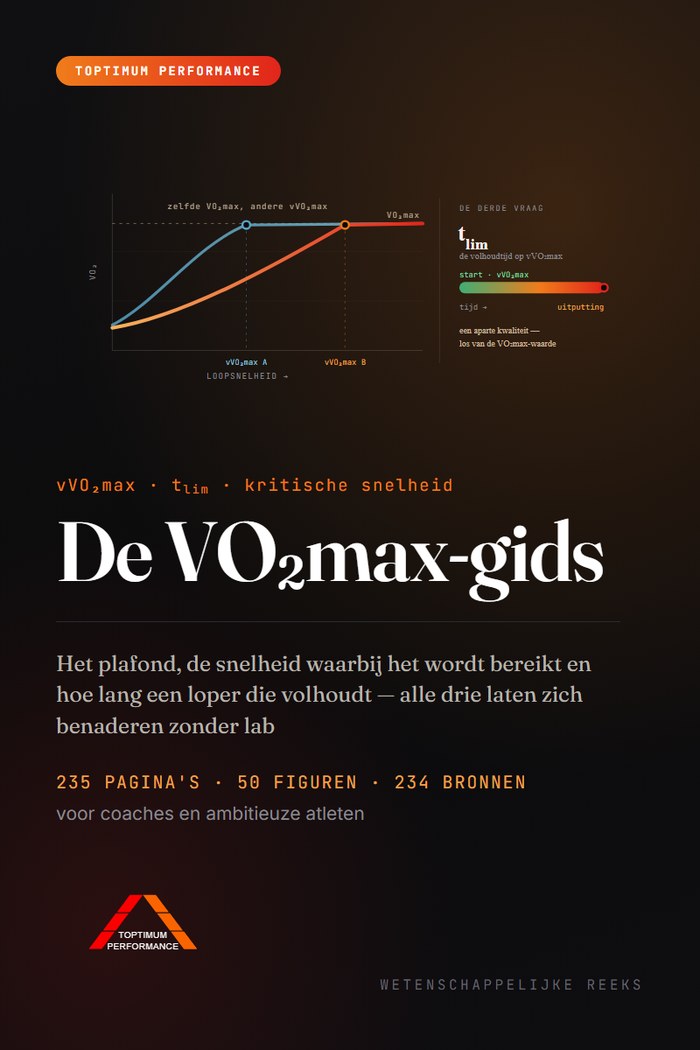
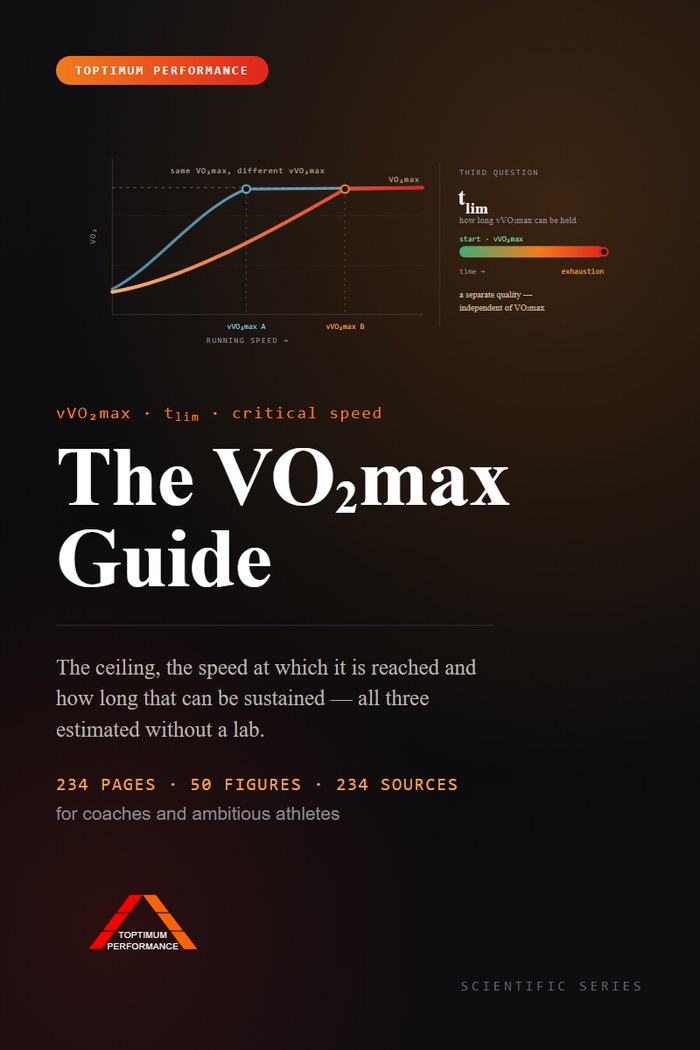
De delen bouwen op elkaar voort: van wat er bij een VO₂max-meting werkelijk gebeurt, over de snelheid en de volhoudtijd die erbij horen en de fysiologie die het plafond bepaalt, tot de trainbaarheid en ten slotte de piste — waar alles uit de vorige delen samenkomt in protocollen, tempo's en splittijden.The parts build on one another: from what really happens during a VO₂max test, through the speed and the time to exhaustion that belong with it and the physiology that sets the ceiling, on to trainability and finally the track — where everything from the preceding parts comes together in protocols, paces and splits.
235 pagina's · 50 originele figuren en 25 tabellen · onderbouwd met 234 wetenschappelijke bronnen, 223 met DOI.234 pages · 50 original figures and 25 tables · backed by 234 scientific references, 223 with DOIs.
Drie dingen die je bij de eerstvolgende training al kunt gebruiken: één over het getal op je pols, één over de vraag voor wie VO₂max-werk het meeste oplevert, en één over de reden waarom twee lopers dezelfde intervalsessie heel verschillend beleven.Three things you can use at your very next session: one about the number on your wrist, one about who gains most from VO₂max work, and one about why two runners experience the same interval session so differently.
Zet je werkelijke HRmax in je gebruikersprofiel — dat is de snelste winst die er te halen valt. Waarom het zoveel uitmaakt: bij matig getrainde lopers bleef de fout van de Garmin Forerunner 245 tussen 2,8 en 4,1 procent, bij hooggetrainde duuratleten liep ze op tot 9,4 tot 10,4 procent, met een onderschatting van ongeveer 6,3 ml/kg/min (Engel e.a., 2026, 35 duuratleten, loopspecifiek). Eén toestel, één studie: de gids leest dat als een waarschuwing bij de waarde, niet als een correctiefactor. Hij legt uit waar de fout vandaan komt — juist de eigenschappen die een goede duurloper goed maken, botsen met de aannames van het algoritme — en waarvoor je dat getal wél prima kunt gebruiken.Enter your actual HRmax into your user profile — the fastest gain available. Why it matters that much: in moderately trained runners the error of the Garmin Forerunner 245 stayed between 2.8 and 4.1 per cent; in highly trained endurance athletes it rose to 9.4 to 10.4 per cent, with an underestimation of about 6.3 ml/kg/min (Engel et al., 2026, 35 endurance athletes, running-specific). One device, one study: the guide reads that as a caution attached to the value, not as a correction factor. It explains where the error comes from — the very qualities that make a runner a good endurance runner are the ones that clash with the algorithm's assumptions — and what the number is genuinely good for.
In een veldstudie met draagbare gasanalyse bij 78 goedgetrainde mannen, elk in de eigen specialiteit, werd VO₂max op álle afstanden bereikt — ook op de sprint. Wat verschilt, is hoeveel van de wedstrijd je daar doorbrengt: rond 3000 m ongeveer de helft, in de marathon zo'n vier procent (Molinari, Edwards & Billat, 2020, geen vrouwen in de steekproef). Eén tabel, en je weet voor welke atleet in je groep VO₂max-werk het meeste oplevert — en voor wie de drempel en de loopeconomie zwaarder wegen.In a field study using portable gas analysis in 78 well-trained men, each in their own speciality, VO₂max was reached at every distance — including the sprint. What differs is how much of the race you spend there: around 3000 m roughly half, in the marathon some four per cent (Molinari, Edwards & Billat, 2020, no women in the sample). One table, and you know which athlete in your group gains most from VO₂max work — and for whom threshold and running economy weigh more heavily.
De tijd tot uitputting op exact 100 procent vVO₂max ligt bij getrainde lopers doorgaans tussen vier en zes minuten (Hill & Rowell, 1996; Billat & Koralsztein, 1996), maar loopt individueel uiteen van ongeveer 2'40" tot ruim tien minuten (Billat e.a., 1996, sub-elite mannelijke lopers, kleine steekproef). En die volhoudtijd hangt nauwelijks samen met de VO₂max, de MAS of de loopeconomie (Billat e.a., 1994, sub-elite mannelijke langeafstandslopers). Het veldprotocol om die volhoudtijd zelf te bepalen staat er stap voor stap in, inclusief het voorbehoud en de veiligheidsvoorwaarden.Time to exhaustion at exactly 100 per cent of vVO₂max typically falls between four and six minutes in trained runners (Hill & Rowell, 1996; Billat & Koralsztein, 1996), but individually ranges from about 2'40" to well over ten minutes (Billat et al., 1996, sub-elite male runners, small sample). And that time to exhaustion barely relates to VO₂max, MAS or running economy (Billat et al., 1994, sub-elite male distance runners). The field protocol for establishing it yourself is set out step by step, including the caveats and the safety conditions.
Deze gids gaat ervan uit dat je met echte lopers werkt en met echte klokken. Herken je jezelf in een van deze punten, dan is hij voor jou geschreven.This guide assumes you work with real runners and real clocks. If you recognise yourself in any of these, it was written for you.
234 wetenschappelijke bronnen, 223 met DOI — van de klassieke modellen tot onderzoek uit 2026. De cijfers zijn nagegaan aan de hand van de oorspronkelijke publicatie: auteurs, jaar, de onderzochte populatie en het cijfer zelf. Komt een bevinding uit fietsonderzoek, uit een kleine steekproef of uit een uitsluitend mannelijke groep, dan staat dat er uitdrukkelijk bij, zodat je meteen ziet of een cijfer op jouw atleet slaat. Alles staat in APA-stijl achteraan, met DOI waar die bestaat; boeken en proefschriften hebben er geen.234 scientific references, 223 with DOIs — from the classical models to research published in 2026. The figures have been traced back to the original publication: authors, year, the population studied and the figure itself. Where a finding comes from cycling research, from a small sample or from an all-male group, that is stated explicitly, so you can see at once whether a figure applies to your athlete. Everything is listed in APA style at the back, with a DOI wherever one exists; books and doctoral theses do not have one.
Voor coaches en ambitieuze atleten · premiumFor coaches and ambitious athletes · premium
Van het plafond naar vVO₂max en volhoudtijd, en van daar naar de piste: welke test je afneemt, welk tempo eruit rolt en welke splittijd op de klok staat.From the ceiling to vVO₂max and time to exhaustion, and from there onto the track: which test to run, which pace comes out of it and which split ends up on the clock.
Je legt hem weg met een plafond, een snelheid en een volhoudtijd voor elke loper in je groep — en met de testen om ze zelf in te schatten.You put it down with a ceiling, a speed and a time to exhaustion for every runner in your group — and with the tests to estimate them yourself.
Bekijk in de storeView in the store →Verkrijgbaar als PDF — prijs in de store. Bekijk daar ook de andere premium gidsen: payhip.com/ToptimumPerformance.Available as a PDF — price in the store. See the other premium guides there too: payhip.com/ToptimumPerformance.
